History

When a kestrel was injured near a small village close to Poděbrady nearly 40 years ago, it had no idea what a huge impact it would have on a young boy, who, thanks to that encounter, would realize that helping animals would become his life's priority.
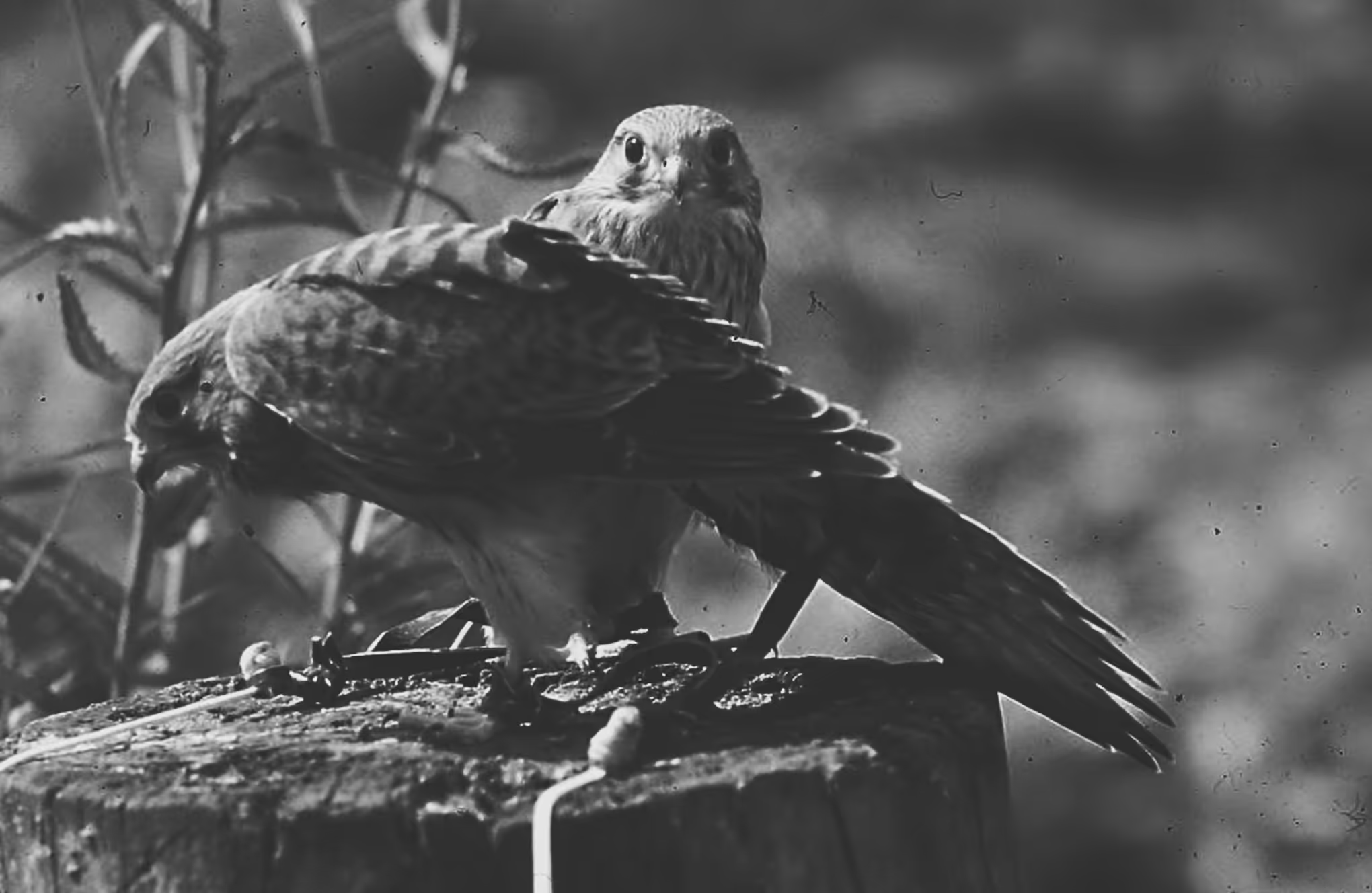
This was at a time when few people were interested in the state of our nature and landscape, and information was truly scarce. And so, the story of one of the first wildlife rescue stations in the Czech Republic began to be written.
The kestrel with the injured wing recovered despite a few minor setbacks and was returned to the wild.
Luboš Vaněk – founder of Huslík (standing on the right in both photos)

A profound experience sparked the desire to establish an organization aimed at helping not only injured animals but also our nature as a whole.

A lot of time has passed since then, and everything has evolved significantly. We have gone from taking in a few dozen animals a year to more than 3,000. Instead of one small room, we have managed to build a facility that provides optimal conditions for animal care while also serving as a center for environmental education.

Huslík milestones

1987

The beginning of our work
The rescue station site in Pátek. The entire area consisted of the garden of Luboš Vaněk's family home

1988

Creation of the National Network of Wildlife Rescue Stations

2008

Purchase of the Klicpera gamekeeper's lodge
The original Klicpera gamekeeper's lodge at the time of purchase

2015

Establishment of the Huslík site and founding of the eco-center

2016

Purchase of land and creation of the nature area at Huslík

2018

Founding of the land trust

2025

Establishment of the forest club

How the name originated

Huslík is the name of the local forest and also the original Klicpera gamekeeper's lodge at Huslík. How did this name come about? We have several theories:

[ 1 ]
The Huslík family, of which there is currently only one family left in the Czech Republic, once owned part of the estate near Poděbrady. There is a story about a prodigal uncle who set out for the estate and got lost in the local woods. Perhaps the woods are named after him?
[ 2 ]
This interpretation is more etymological – there was a brickworks near Huslík, which can also be found on the 2nd military survey from the years (1806–1869). The brickworks was referred to as "die Ziegel," and a cottage or hut as "Hütte." It is possible that the term "Hütte Ziegel" became embedded in people's memories and gradually changed to "Hutzlieg" and eventually "Huslík."
[ 3 ]
Chotětice: A fortress and village near Poděbrady, in the 19th century the Huslík brickworks, and now a house for the town gamekeeper. The small fortress was situated on the bank of the old Elbe river: 1345 castrum Poidibrad cum villis Sboschie. Sedláček explains the name Huslík in his posthumous papers as originating from the earlier Voslík, but he does not cite his source, so we cannot verify it.

Hohenlohe Gamekeeper's Lodge

The site where our complex stands has been used since ancient times. Its value was also recognized by the founder of the spa, Prince Ernst Philipp of Hohenlohe. He established a gamekeeper's lodge at Huslík as a base for his favorite pastime – hunting. And this is where the modern history of the site begins. The lodge remained in use after Hohenlohe's death until the 1970s.
Coat of arms of the Princes of Hohenlohe
The last gamekeeper to live in the lodge was Mr. Klicpera. From the 1980s onwards, the building fell into disrepair until our organization managed to purchase it from the town of Poděbrady. We subsequently prepared a project to build a modern rescue station complex. Construction of the entire facility was completed in 2015.
Klicpera's gamekeeper's lodge in 1956